PRP Hair Treatment – Effective PRP Injections for Hair Regrowth


Reviewed by Dr. Ravali Yalamanchili
MBBS- Prathima Medical College
MD-JSS University, Mysore.
One of the common problems that many people encounter at some point in their life is hair loss. Some may simply resign themselves and see it as part of aging, others attempt to reclaim both their hair and their confidence.
One treatment that has become popular and is natural hair growth stimulating, is Platelet Rich Plasma (PRP) therapy.
Among the many treatments available, one that has gained a lot of attention for its use of natural hair growth stimulation is Platelet Rich Plasma (PRP) therapy.
This comprehensive guide would be discussing PRP hair treatment along with its benefits, procedure, and why this is a breakthrough for hair restoration.
What is PRP? The Science Behind It
Platelet-Rich Plasma, is extracted from your blood by separating blood components. Blood consists of five components.
Plasma, the liquid part of blood, and platelets, tiny pieces of cells essential to the body’s healing and regenerative processes.
Small amounts of your blood are drawn, spun in a centrifuge to separate the platelets and then the platelet-rich liquid is reinjected into targeted areas of the scalp.
The growth factors in these platelets will reinstate the body’s natural healing cascade that improve blood circulation towards hair follicles which enlarge them in turn stimulates healthier hair growth.
It is a safe and effective treatment because it uses the body’s own natural healing factors to regrow hair follicles.
How PRP Works? : Breakdown Step by Step
The process of PRP therapy for hair restoration is simple but effective and can be divided into three main steps:
- Blood Collection: A small volume (10-20 ml of blood) is extracted from your arm. This step is as painless as a standard blood test.
- Centrifugation: The harvested blood is transferred to a centrifuge, a machine that spins it at high velocities to segregate its various components. The red blood cells sink below the lighter plasma, and the platelet-rich plasma is drawn off. This plasma is now rich with an increased amount of platelets involved in the activation of hair growth.
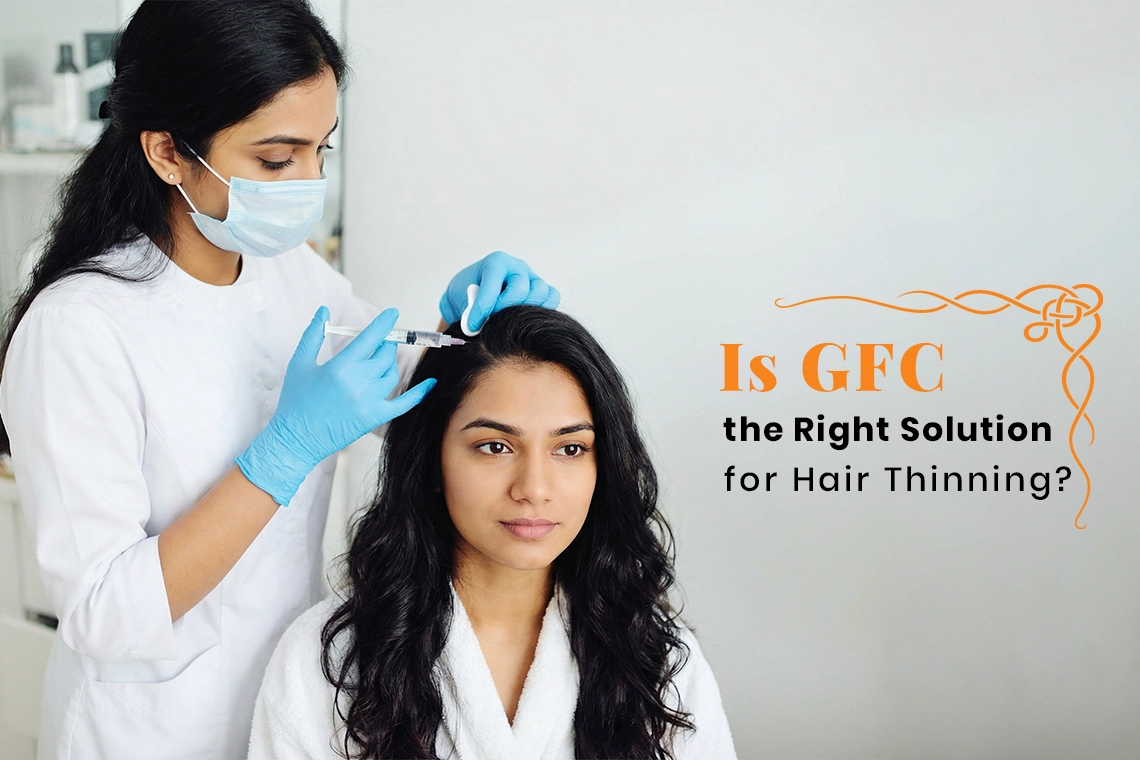
- Injection into the Scalp: The prepared PRP is injected into the thinning or balding areas of the scalp. It is determined with much care where to inject as it is dependent on the pattern and severity of hair loss.It is minimally invasive and takes around 30-45 minutes. You will feel slight discomfort during the procedure, but majority of the patients don’t complain of pain.
It can be uncomfortable at times, but it doesn’t hurt for most people.
PRP contains numerous natural growth factors that can help stimulate and reactivate your hair follicles to form fresh and healthy hair.
PRP is rich in natural growth factors that stimulate your hair follicles to produce new healthy hair.
The PRP itself contains a large number of natural growth factors which work in conjunction with your hair follicles to boost new, healthy hair growth.
Key Ingredients in PRP for Hair Treatment
PRP therapy relies on its foundational building blocks–platelets–to facilitate hair restoration and beneath them are a host of growth factors essential to this process.
These growth factors help to regenerate and heal the hair follicles. Key growth factors identified in PRP include:
- PDGF (Platelet-Derived Growth Factor): PDGF accelerates cell division and migration to accelerate some healing processes. This kick-start the activity in hair follicles and regrow if the same is regenerated.
- Growth Factor-Beta (TGF-β) : It is a TGF-β growth factor. It serves for the proliferation of the cells and for their maturation, regeneration and repair. This growth factor is used in cell development, regeneration, and repair. It stimulates natural collagen and other protein production by the body, needed in tissue restoration to promote hair follicle growth.
- Vascular Endothelial Growth Factor: VEGF is essential because it helps promote blood circulation by assisting with the angiogenesis, the forming of the blood vessels themselves. The new blood vessels now grow and allow for blood to be passed through to enhance circulation to the hair follicle, meaning more nutrients and oxygen can get to strands to feed them.
All of these growth factors work in concert to help restore hair follicles, density of hair, and growth of healthy hair.
PRP Hair Treatment Process: What to Expect
If you decide to have the PRP hair restoration therapy, understanding the procedure can be really crucial so that you know what exactly to expect during the therapy. Here are some details of the treatment.
- Initial Consultation: It is during a first consultation when the treatment procedure is made, which follows evaluation by an expert against your degree of hair loss, your medical background to decide how useful PRP treatment will be for your situation. These people will show you the ways the treatment shall proceed and in this way facilitate reasonable expectations pertaining to the output of the entire treatment process.
- Blood Draw: A small amount of blood will be taken from your arm. The process is fast and generally painless.
- Processing the Plasma: It separates the plasma through a centrifuge, giving two sections separated from each other. One side consists of a platelet-rich plasma, whereas the other constitutes the red blood cells. All this will be fully processed and ready in a total of 15-20 minutes.
- Injection to the Scalp: The prepared plasma is injected to all the bald areas of your scalp.
- Post-Procedure: There will be some redness and swelling at the injection sites which is normal and usually resolves within a few short hours to a day. You should not even do any heavy exercising for a couple of days, and avoid any hair dye, chemical treatments of any kind for about seven days after.
PRP in Hair Restoration: Why it is a game-changer
PRP therapy is better known for its benefits compared to conventional hair restoration methods. Some of the main advantages are:
- Non-invasive & minimally invasive: PRP is an entirely non-surgical process, i.e, it is not invasive like a hair transplant surgical procedure, where your body gets cut stitches.
- Utilises Your Own Blood: Since PRP utilises your very own blood, there will never be sensitivities or another issue of an outside substance.
- Quick Recovery Time: The downtime following PRP treatment is very minimal. Most people return to their things right away, with little to no downtime.
- Encourages Healthy Hair Growth : PRP not only prevents hair loss, but helps hair regrow healthily by revitalising the hair follicle. This causes the newly growing hair to be strong and thick and healthy.
- Long-Term Outcomes: With regular treatments and upkeep, PRP can offer long-term benefits.
Eligibility for PRP Hair Treatment — Who Can be a Candidate?
It is most appropriate for individuals in the early stages to moderate hair loss. This is particularly effective for those with androgenetic alopecia, also known as male or female pattern baldness.
PRP can help delay hair loss, increase hair density, and encourage new growth.
However, it is not suited for everyone. It is not very effective for those who have progressed hair loss wherein the hair follicle no longer produces hair.
PRP treatment may not also be suitable for people with some medical conditions like blood disorders or an active scalp infection.
PRP is suitable if a consultation with a specialist determines that you are dealing with appropriate hair loss.
PRP Hair Treatment and How It Measures up Against Other Options for Hair Restoration
Nowadays, there are multiple techniques when it comes to hair restoration treatment.
One among them is PRP therapy. Here’s how PRP compares with other major techniques:
|
Treatment |
PRP |
Hair Transplant |
Oral Medications |
Laser Therapy |
|
Description |
Non-invasive procedure that stimulates hair follicles using growth factors to revive hair. Minimal downtime. |
Invasive procedure that transfers hair follicles from a donor area to thinning or bald areas. Requires longer recovery time. |
Oral meds like minoxidil and finasteride can slow hair loss but do not promote new hair growth. |
Low-Level Laser Therapy uses light to stimulate hair follicles. Less targeted than PRP. |
|
Effectiveness |
Encourages new hair growth and revitalizes existing hair follicles. |
Effective but requires a longer recovery time. |
Slows hair loss, but does not stimulate new hair growth. |
Non-invasive but less targeted than PRP. Primarily uses light instead of growth factors to stimulate hair follicles. |
|
Downtime |
Minimal downtime. |
Longer recovery time due to the invasiveness of the procedure. |
No downtime required. |
Minimal downtime. |
|
Targeted Approach |
Directly targets hair follicles using growth factors for more noticeable results. |
Targets balding areas by transplanting follicles. |
Slows hair loss without targeting specific follicles. |
Non-targeted, uses light for a general effect. |
|
Conclusion |
More pronounced effects in promoting hair growth with minimal downtime. |
More invasive and requires more recovery time, but can provide permanent results. |
Slows hair loss but does not regenerate hair follicles. |
Non-invasive but less specific in comparison to PRP. |
Aftercare Tips for PRP Hair Treatment
PRP is a minimally invasive treatment, but patients must adhere to aftercare directions to achieve the best possible results.
Essential Aftercare Tips Remember:
- Do not touch the Treated Area: Do not touch, massage or scratch your scalp for at least 24 hours to prevent irritation or infection.
- Stay Out of the Sun: For a few days following your treatment, avoid letting any direct sun radiation onto your scalp. This will help prevent redness or irritation.
- Limit Hair Products: Avoid hair products such as shampoos, conditioners or styling gels for a few days after your treatment to avoid irritation on the area.
- Regular Appointments: Follow-up appointments are necessary, and though it will take a couple of months before full hair growth is apparent, follow up is important in keeping your hair growth steady, and maintenance treatments are scheduled.
How Long Does PRP for Hair Restoration Last?
Within 3-6 months, most patients will notice an improvement in hair growth. To achieve the best results, a cycle of 3-4 treatments 1 month apart is usually advised.
Depending on how well the results are maintained and how advanced is the growth process, an average maintenance the treatment might be required every 6 to 12 months.
how long the results will last will vary based on how much of your hair is lost, your lifestyle, and how well your body responds to the therapy.
Conclusion
PRP treatment is an advanced, non-invasive hair loss solution that gives the body a natural way to stimulate hair growth and prevent further loss.
Whether experiencing male or female pattern balding, stress-thinning, or other forms of hair loss, PRP stimulates hair growth by stimulating the cells in your scalp.
If you want to find a safe, effective, and long-term solution for hair loss, then PRP could be your best bet.
Get a consultation from a qualified professional in the said treatment and see how this revolution can bring your hair back to you.
For enhanced and longer-lasting results, many specialists also recommend GFC treatment in Hyderabad as an advanced alternative to PRP. This innovative therapy uses concentrated growth factors to strengthen hair follicles, reduce thinning, and promote natural regrowth with safe and effective results.
For advanced hair rejuvenation and long-lasting results, consider GFC treatment, alongside PRP therapy. Neya is one of the top skin & hair clinics in Jubilee Hills, Hyderabad.
Read More: